Introduction to web3 and the decentralized web
Drafted December 2022. Finished and published August 2026 as part of the migration away from WordPress.
Web3, also known as the decentralized web, is a term used to describe the future vision of the internet in which users have complete control over their own data and the ability to interact with one another directly, without the need for intermediaries such as central servers or third-party companies. This is made possible by a combination of decentralized technologies, such as blockchain and peer-to-peer networking, which allow for the creation of secure and trustless networks that are not subject to the control of any single entity.
Web2 and Web3 at a glance
| Web2 | Web3 | |
|---|---|---|
| Your account | A username and password held by each company | A private key held in a wallet |
| Logging in | The company checks your password | You sign a message that others can verify |
| Your name | A handle controlled by the platform | An ENS name recorded on Ethereum |
| Files | Stored on a company’s server at an address | Stored by content hash and hosted by peers |
| Exchange | A company matches buyers and sellers | A smart contract manages a liquidity pool |
| Who can switch it off | The company operating the service | No single operator controls the network |
Decentralized finance
Defi, short for decentralized finance, is a growing movement within the world of finance that aims to use these decentralized technologies to create financial products and services that are open, transparent, and accessible to anyone, regardless of their location or financial status. Defi uses smart contracts, which are self-executing contracts with the terms of the agreement between buyer and seller being directly written into lines of code, to automate financial transactions and enable the creation of new financial instruments, such as lending and borrowing platforms, stablecoins, and decentralized exchanges.
One of the key advantages of web3 and defi is that they allow for the creation of financial systems that are more resilient and resistant to censorship, fraud, and other forms of abuse. Because decentralized networks are not controlled by any single entity, they are less vulnerable to attack, and because smart contracts are transparent and auditable, they can provide greater security and trust for users. In addition, because defi is built on open protocols and standards, it allows for the creation of a wide range of financial products and services that are accessible to anyone, regardless of their location or financial status.
Removing the intermediary
Another key benefit of web3 and defi is that they enable users to interact with one another directly, without the need for intermediaries such as banks or financial institutions. This not only reduces the cost of financial transactions, but also allows for the creation of new financial instruments and services that were not previously possible. For example, defi allows for the creation of decentralized exchanges, where users can trade cryptocurrencies and other digital assets directly with one another, without the need for a central authority. This not only reduces the cost of trading, but also allows for the creation of new markets and assets that were previously not possible.
Uniswap V1 and V2
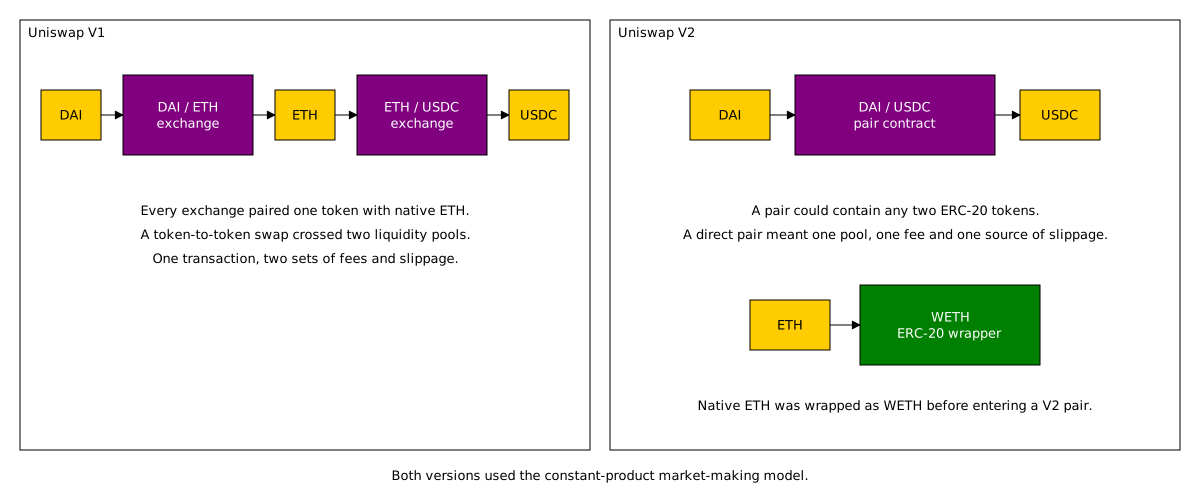
Uniswap V1 required every exchange to pair an ERC-20 token with native ETH. A DAI-to-USDC trade could complete in one transaction, but it crossed two pools through ETH. V2 allowed arbitrary ERC-20 pairs, so the same trade could use a direct DAI/USDC pool. V2 represents native ETH as WETH when it is used in a pair.
Sources: Uniswap V1 documentation and the Uniswap V2 whitepaper.
Challenges
Despite these benefits, web3 and defi are still in their early stages, and there are many challenges and limitations that need to be addressed before they can reach their full potential. One of the biggest challenges is scalability, as decentralized networks are currently not able to handle the same level of transaction volume as centralized systems. In addition, the complexity of decentralized technologies can be a barrier to adoption, and there is a lack of clear regulations and standards in the defi space.
Where it could lead
Overall, web3 and defi represent a significant shift in the way that we think about the internet and finance, and have the potential to create new opportunities and possibilities for users around the world. As these technologies continue to evolve and mature, we can expect to see the development of a wide range of new financial products and services that are open, transparent, and accessible to anyone.