Blockchain Consensus Algorithms: PoW, PoS, PoA and Hybrids
Drafted December 2022. Finished and published August 2026 as part of the migration away from WordPress.
Consensus algorithms are a critical part of blockchain technology, as they determine how the network reaches agreement on the state of the ledger and the validity of transactions. There are several different types of consensus algorithms, each with its own unique features and characteristics. Some of the most well-known consensus algorithms include proof-of-work, proof-of-stake, proof-of-authority, and hybrid consensus algorithms.
The four approaches at a glance
| Proof-of-work | Proof-of-stake | Proof-of-authority | Hybrid | |
|---|---|---|---|---|
| Who writes the next block | Whoever finds a valid hash first | A validator selected from the staked set | A validator from an approved set | Depends on the mechanisms combined |
| What secures it | Electricity and hardware | Capital locked as stake | Validator identity and reputation | Two or more security mechanisms |
| Cost of attacking it | Acquire more hashrate than the honest network | Acquire substantial stake and risk slashing | Compromise the approved validator set | Overcome each mechanism in the design |
| Main trade-off | Energy use and specialist hardware | Stake concentration | Reliance on a limited validator list | Additional protocol complexity |
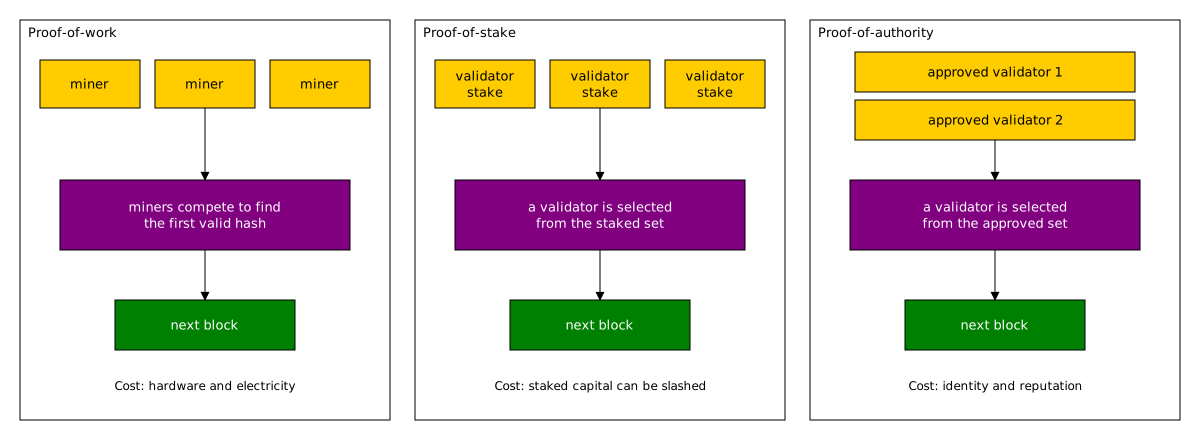
Three different answers to the same question: who gets to write the next block, and what do they stand to lose if they cheat?
Proof-of-work
Proof-of-work is a widely used consensus algorithm, and is used by networks such as Bitcoin and Ethereum Classic. Ethereum used proof-of-work until it transitioned to proof-of-stake in September 2022. In a proof-of-work system, nodes on the network compete to solve complex mathematical puzzles in order to validate transactions and add them to the blockchain. This process, known as mining, requires a significant amount of computational power, and the node that solves the puzzle first is rewarded with a block reward. One of the key advantages of proof-of-work is that it provides a high level of security, as it is difficult for an attacker to gain control of the network without a significant amount of computational power. However, one of the main disadvantages of proof-of-work is that it is energy-intensive and can be expensive, which can limit the scalability of the network.
Proof-of-stake
Proof-of-stake is a consensus algorithm that is gaining popularity, and is used by networks such as EOS and Cardano. In a proof-of-stake system, nodes on the network are chosen to validate transactions based on their stake, or the amount of cryptocurrency that they hold. This means that the more cryptocurrency a node holds, the more likely they are to be chosen to validate a transaction and receive a reward. One of the key advantages of proof-of-stake is that it is more energy-efficient than proof-of-work, as it does not require nodes to solve complex mathematical puzzles. In addition, proof-of-stake can provide a higher level of security, as it is difficult for an attacker to gain control of the network without a significant amount of cryptocurrency. However, one of the main disadvantages of proof-of-stake is that it can be subject to centralization, as nodes with a large stake are more likely to be chosen to validate transactions.
Proof-of-authority
Proof-of-authority is a consensus algorithm that is used by networks such as POA Network. In a proof-of-authority system, nodes on the network are chosen to validate transactions based on their identity, which is verified by a trusted authority. This means that only nodes that have been verified by a trusted authority are able to validate transactions and add them to the blockchain. One of the key advantages of proof-of-authority is that it is fast and efficient, as only a small number of nodes are needed to validate transactions. In addition, proof-of-authority can provide a high level of security, as only nodes that have been verified by a trusted authority are able to participate in the network. However, one of the main disadvantages of proof-of-authority is that it is subject to centralization, as the trusted authority has a significant amount of control over the network.
Hybrid consensus algorithms
Hybrid consensus algorithms are a combination of two or more different consensus algorithms, and are designed to combine the advantages of different consensus algorithms while minimizing their disadvantages. For example, a hybrid consensus algorithm might use proof-of-work to provide a high level of security, and proof-of-stake to improve scalability and reduce energy consumption. Hybrid consensus algorithms are still relatively new, and are being developed and tested by a number of different networks.
Summary
Overall, consensus algorithms are an important part of blockchain technology, and play a critical role in determining the security, scalability, and decentralization of a network. Different consensus algorithms have their own unique features and advantages and disadvantages, and the best algorithm for a particular network will depend on its specific needs and requirements. As blockchain technology continues to evolve and mature, we can expect to see the development of new consensus algorithms and the emergence of new innovations in this space.